
Practice Instructions
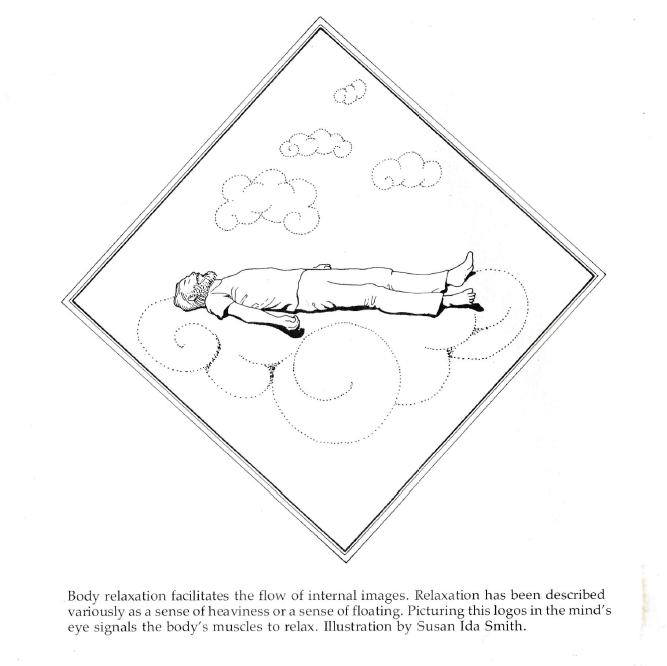
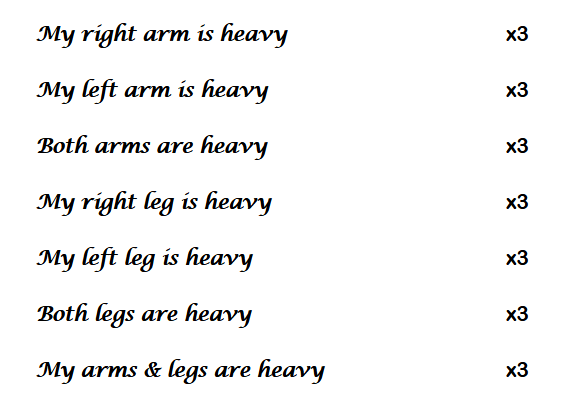
The aim of this first exercise is to bring on deep muscle relaxation in your limbs. This happens by mentally repeating suggestions to yourself—in your mind, not aloud—that you can feel the full weight of your arms and legs. These autosuggestions, or autogenic mantras, progress methodically through each limb in turn, bringing on pleasant sensations of heaviness, fullness, and stillness.
Each mantra is recited mentally three times. This rhythmic repetition is carried out in an effortless, casual, easy way—promoting both physical and mental relaxation. The inner recitation also improves concentration by keeping the verbal part of your mind occupied, reducing distractions from the constant chatter of inner speech.
Practise in bed, an armchair, or a recliner. Ensure your body position is comfortable, straight, and symmetrical. Adopt precisely the same body position each time.
Left-handers should begin with “My left arm is heavy” and continue with a mirror image of the sequence.
Dual Attention
Practice involves dual attention—keeping your awareness on two things simultaneously:
- Saying the words to yourself;
- Making full mental contact with the part of the body you are focusing on—feeling that part continuously and in as much detail as possible.
As you recite the mantras rhythmically, feel each arm or leg as a single unit stretching from shoulder joint to fingertips, or hip joint to toes.
This first exercise involves feeling yourself letting go of the limb, detaching from it, surrendering it to the gravitational field of planet Earth.
The Process of Letting Go
Relaxation equals letting go—physically releasing muscles and mentally releasing all concern with any issues.
The word “heavy” automatically triggers letting go, detachment, and relaxation. This happens because of our accumulated experience carrying heavy objects separate from our body (children, luggage, shopping bags). We associate the word “heavy” with objects distinct from ourselves.
When you suggest to yourself that an arm or leg feels heavy, your mind automatically assesses its weight, as if asking “Is it heavy?” To do this, it must let go of the limb, treating it as a separate object. As soon as you release the muscles, the limb becomes floppy and relaxed, resting more heavily on whatever supports it.
Let the Words Work for You
The key is to adopt an attitude of passive concentration and let the words work for you—as if the autogenic mantras are magic spells in a fairy tale. You don’t need to try and actively make your arm to feel heavy. Simply saying the words does it for you, especially when repeated three times.
In fairy tales, magic spells are traditionally spoken three times. Similarly, emergency announcements are often repeated three times over loudspeakers in public places. Saying something three times signals its importance.
We normally ignore the weight of our limbs, treating them as weightless. When active through the day, feeling heaviness in our limbs indicates fatigue or illness. You want to feel this heaviness only when resting or falling asleep.
The Attitude of Allowing
Avoid striving or actively trying to make the heaviness happen. Allow it to happen rather than forcing it. Trying too hard creates tension, counteracting relaxation. Your attention should rest on the limb passively and receptively, experiencing all sensations in detail.
Don’t send active commands down to your limb telling it to feel heavy. Instead, broadcast suggestions out to your unconscious, as though asking it to release tension and let the limb go floppy. Autogenics fosters partnership and deeper connections between mind and body, conscious and unconscious.
It’s undeniable that your arms and legs have weight—gravity exists. You can therefore repeat the heaviness phrases with complete confidence in their truth. The way you say the words to yourself in your mind can carry the soothing conviction of this truth.
Alternatives to Exercise Structure
After sufficient practice you can shorten the exercise down to repetition of briefer mantras, e.g. “Right arm heavy . . . right arm heavy . . . “, or simply “Heavy . . . heavy . . .heavy” while simultaneously focusing the spotlight of attention onto the relevant limb.
Instead of the slightly militaristic right-left-right-left sequence as shown you might prefer to rotate around the limbs in a circular fashion: Right arm—Left arm—Left leg—Right leg.
Or, and this was the way Autogenic Training was first practised, start with the right arm (left if left-handed) and then pause to see which limb “wants” to go heavy next, i.e. begins spontaneously to feel heavier.
Feel free to experiment with different wordings and variations to find what works best for you: “Heavy is my right arm”—”My right arm heavy is”—”Right arm heavy heavy”
Autogenic Discharge
Along with heaviness, you may notice various stress-release phenomena in your limbs or other body parts. These commonly include small muscle twitches and tingling sensations.
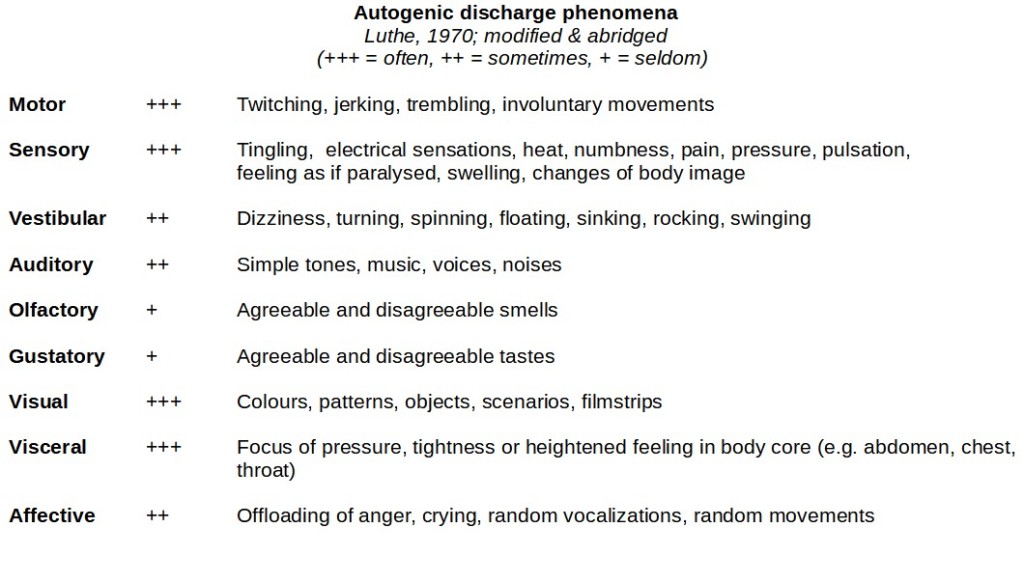
These phenomena represent the beneficial clearing of stress and tension from body-memory. Research shows that autogenic discharges often relate to past trauma, adversity, and deprivation. The tingles and twitches represent your brain’s self-healing activity releasing accumulated disturbance. Autogenic discharges typically come in phases with characteristic patterns unique to each individual that evolve over time.
This diagram shows the frequency of different types of discharge over a six month period as the parctitioner progressed from practice of Standard Exercise I to Standard Exercise VI, experiencing a lot of palpitations in June (column C), seeing a lot of monsters in September (column G) with anxious feelings (column H), and gradual disappearance of symptoms (column K) over the autumn months:
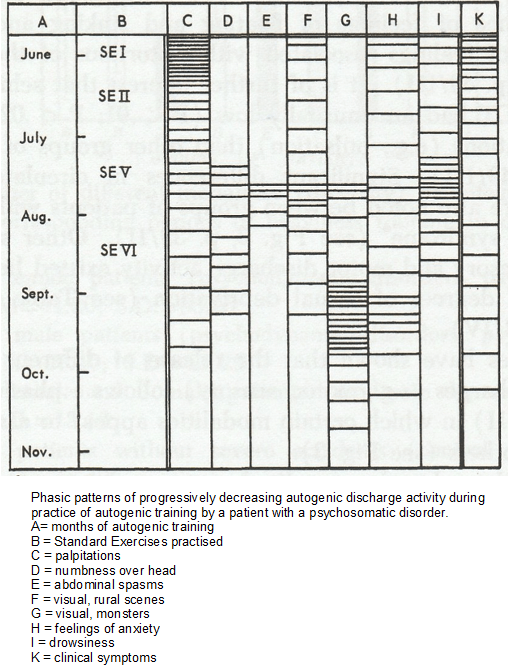
With continued long-term practice, physical discharge activity tends to subside, replaced by visual discharge (visual pseudo-hallucinations, visions).
Visions emerge from the unconscious initially as simple visual imagery of colours and patterns, progressing with practice into complex hallucinations involving dream-like scenes and filmstrips.
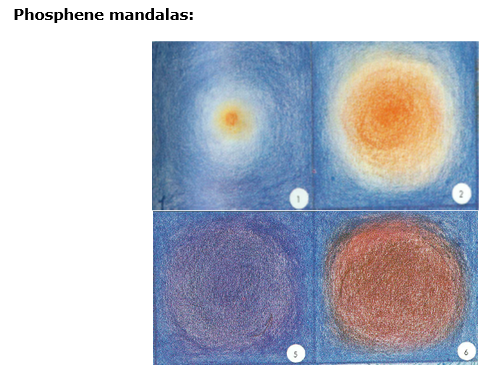
You might notice elementary levels of visual hallucination, like these central blobs of colour, in bed at night when you are in a hypnagogic state, the threshold state between waking and sleeping. Hypnagogic hallucinations are similar to those which occur in the autogenic state and with deepening relaxation show the same hallucinatory progression from elementary to complex levels.
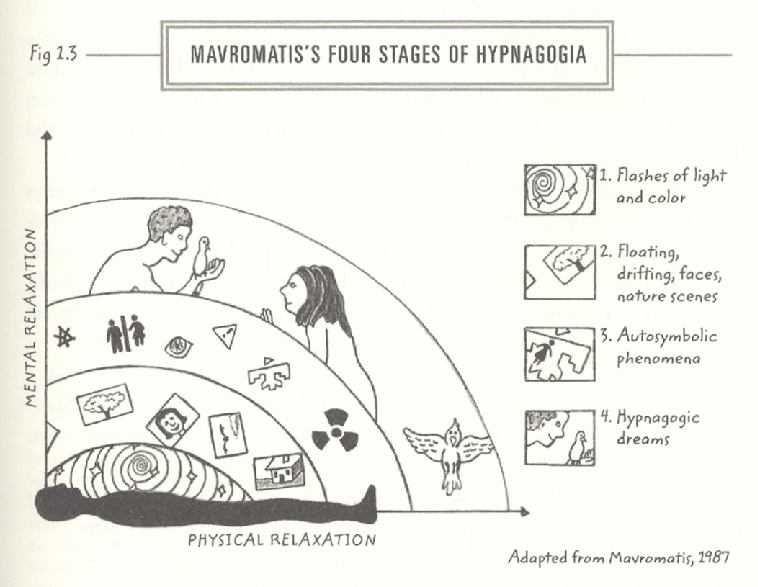
For a detailed description of the hallucinatory progression see Levels of Ganzflicker-Induced Visioning on the Strobonaut website:


Copyright REM Autogenics – All rights reserved
 REM Autogenics